Introduction to energy and macroeconomic models

ThreeME team

OFCE, NEO

22 septembre 2023

1 Contents

  • Model tools applied to climate change:

    • Why do we need models?
    • Limits of existing models
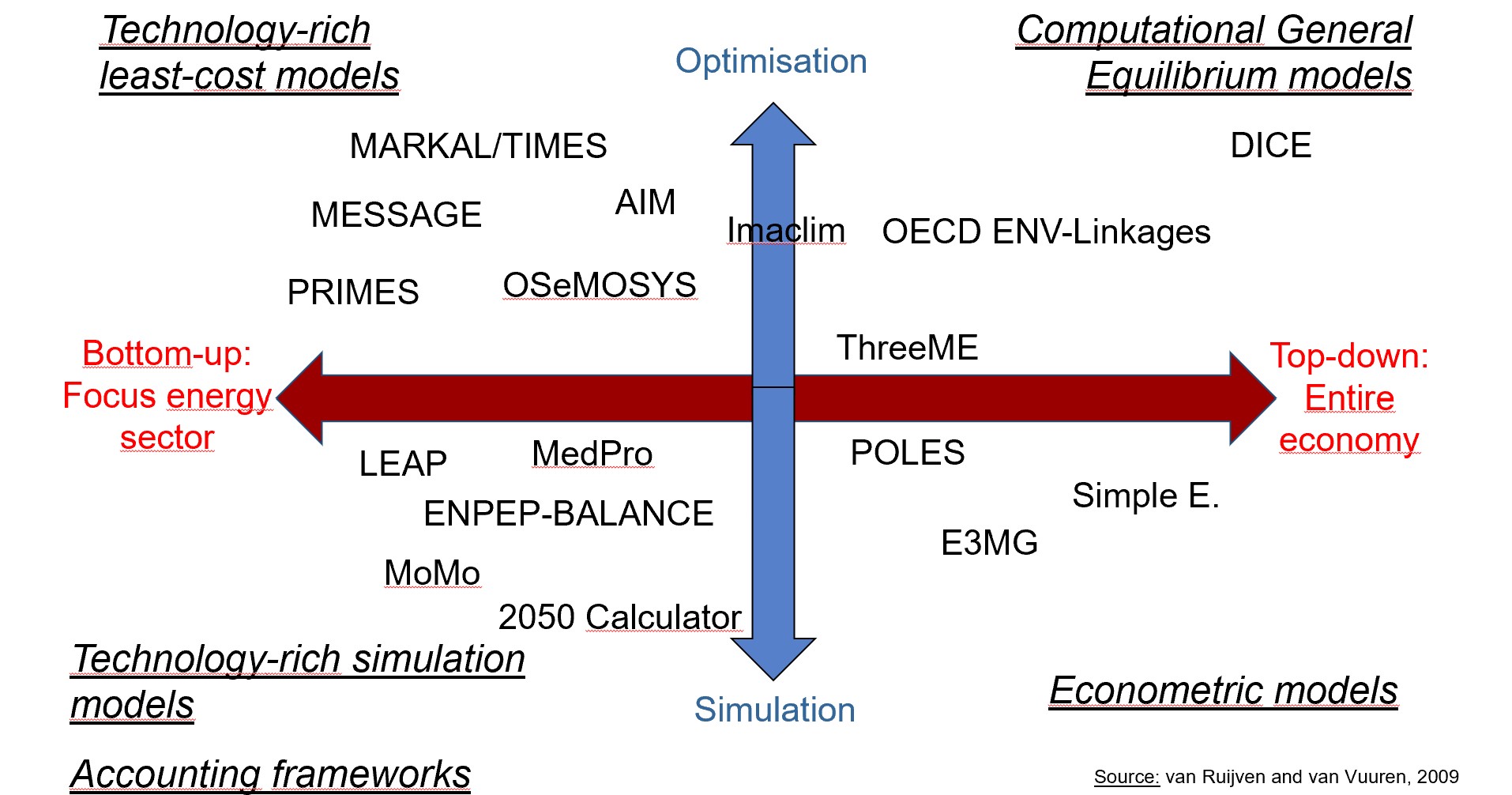
    • Bottom-up versus top-down approaches
    • Main existing models
  • The ThreeME model

    • Context of the creation of the model
    • Main characteristics

2 Model tools applied to climate change

  • Context

    • To keep global warming from rising more than 2°C compared to pre-industrial levels, OECD countries are expected to reduce their greenhouse gas (GHG) emissions by 80-95% by 2050 compared to 1990.
    • Kyoto protocol where countries have agreed to meet emission reduction targets
    • Accentuated by the global Paris’ agreement in 2015 during the COP21
    • Most countries have pledged to cut drastically GHG emissions
    • Part of the Sustainable Development Goals (SDG)
      • No trade off between economic & environmental objectives
      • Environmental policy seen as an economic opportunity
      • Energy security
      • « Green » industry and technology use high skilled jobs

3 Why do we need models?

  • Strong research need in economic evaluation

    • Ex post and ex ante impact assessments of climate/energy policy
      • Impact of the energy transition
      • Need of new indicators (Beyond GDP)
  • Difficult task requiring a detailed analysis and a lot of data

    • Many heterogeneous, targeted measures for many countries
  • Applied economic models: one of the main tools

    • Costs & impact assessment of policy measures
  • But existing models have limits

    • Lack of details or realism
    • Research need in model development

4 Limits of existing models

  • Measure poorly certain side effects of environmental policies

    • Rebound effects & wealth effects
      • Ex: house insulation for poor households
      • Often energy consumption depends on revenue and not on the number of cars or buildings
      • Often only one consumer
    • Impact on inequality
    • Endogenous energy efficiency
  • Say little about the short and medium term

    • Maybe because climate change is a long term phenomenon
    • Although most people agree on the long term beneficial effects of climate policy, the acceptability of climate policies depends on their short term impacts
      • Ex: rejection of Kyoto by the USA; of the carbon tax in France
  • Effect on non-economic indicators

    • Sustainability
    • Environmental and social aspects of progress

5 Bottom-up versus top-down approaches

  • Bottom-up: « from the detailed to the aggregate level »

    • Advantages: realism and high level of detail
    • Drawbacks: neglect indirect effects
      • Ex: effect of energy savings on prices (which in return will affect energy savings themself)
  • Top-down: « from the aggregate to the detailed level »

    • Advantages: accounts for interactions/feedbacks
      • Rebound effects: a lower energy bill means an extra revenue which in return may lead to more energy consumption
      • Carbon leakage
    • Drawbacks: lack of details, unrealistic representation of certain economic behaviours such as energy consumption

6 Universe of energy & climate models

7 Main existing models

  • Computational General Equilibrium Models (CGEM)

  • Neoclassical Integrated Assessment Models

  • Engineering models / energy system models

  • Hybrid models: combination of the three above

8 Computational General Equilibrium Models (CGEM)

ENV-Linkages (OECD), GTAP

  • Walrasian models: perfect price flexibility guaranties equilibrium on each market at every period

  • Typical applications:

    • Effect of the change in technical progress
      • Climate change will degrade productivity in certain sectors. This will lead to the increase of the production price of these sectors. Agents will react/adapt by substituting goods or input
    • Effect of a tax on emissions
  • Limits:

    • Long term models: do not say much about the short and medium term.
      • Ex: no unemployment
    • Lack of details about the drivers of energy consumption

9 Neoclassical Integrated Assessment Models

DICE (Nordhaus)

  • A representative agent maximizes the future welfare of the entire society by making a trade off between the benefits of economic growth (consumption) and its costs (emissions)

  • Typical applications:

    • The value and trajectory of the optimal carbon tax
      • Climate change has a cost in terms of (future) wealth but mitigation also has a cost. Weighing these 2 costs defines the optimal growth that allows the maximum wealth in the future
  • Limits:

    • Perfect insight/information about the future
    • Largely normative: an economic « dictator » who decides for all the society (the whole world)

10 Engineering models / energy system models

MARKAL, PRIMES (European Commission), POLES, LEAP.

  • A representative agent minimizes the future energy costs of the society by choosing the optimal energy mix

  • Very detailed representation of all technical energy processes

    • Costs (production, distribution, etc), availability
  • Typical applications

    • When (or under which circumstances) a given technology will be profitable?
    • How will the most cost effective energy mix evolve in the future?
  • Limits:

    • Partial equilibrium: exogenous prices
      • No vision of the global economic system
    • Largely normative: the economic « dictator »